Recent public records released by the City of Battle Ground reveal that Mayor Eric Overholser took a series of secret steps to remove City Manager Kristina Swanson in August 2026. Instead of working openly through City Hall, records show the Mayor met privately with police leadership off city property, used artificial intelligence (AI) to draft the firing paperwork, and turned off document tracking to hide edits.
1. Secret Meetings at a Private Office
In Battle Ground’s system of government, the City Council sets policy, while the City Manager runs daily operations and oversees all staff—including the police. Under Washington State law (RCW 35A.13.120), council members and the mayor are barred from going behind the manager’s back to direct or manage city employees.
Text messages show that in late July 2026, Mayor Overholser bypassed the City Manager to contact Lieutenant Jason Perdue, who was serving as Acting Police Chief:
- The Location: Rather than meeting at City Hall, Overholser texted Perdue: “We can meet at my office: 1608 SE Commerce Ave”—the Mayor’s private business property.
- The Hand-Off: Days later, Perdue delivered a written statement regarding Swanson directly to the Mayor at that private office.
By setting up private meetings off city grounds to gather statements from subordinate staff, the Mayor stepped outside his legal role and interfered directly with administrative employees.


2. Grok-Drafted Resolutions and Personal Email Routing
Rather than directing the City Attorney’s office to draft official council legislation, Mayor Overholser turned to external artificial intelligence.
On August 4, 2026, at 7:35 PM UTC, Overholser emailed the draft of Resolution No. 26-05 from his personal Gmail account (ericoverholser@gmail.com) to his official city email address (eric.overholser@cityofbg.org). The resolution cited termination without cause under RCW 35A.13.130, authorized 12 months of severance, and placed Swanson on immediate administrative leave.
City Clerk public records confirmations show that city legal staff never drafted this resolution.
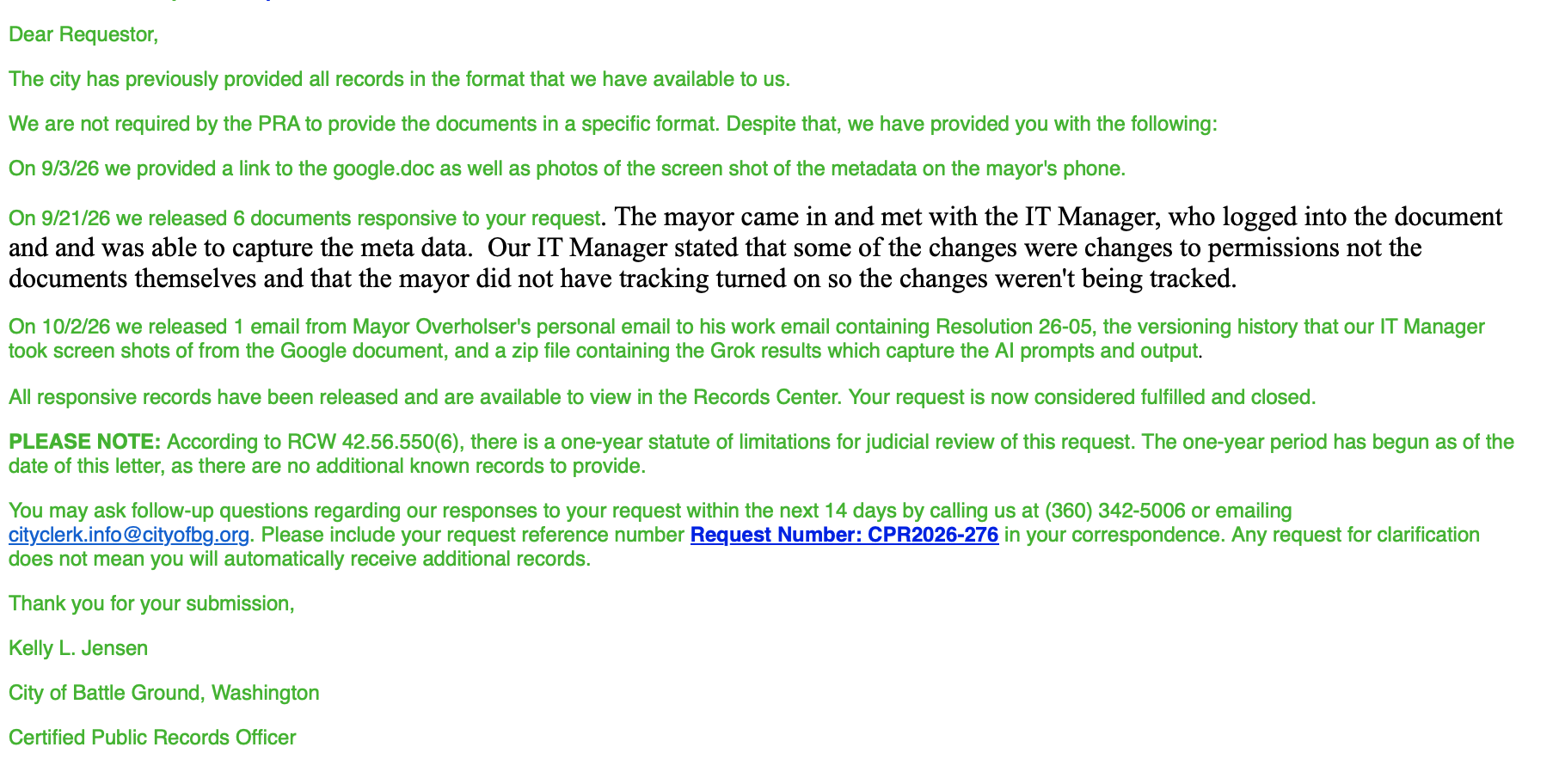
Instead, records fulfillment CPR2026-276 included:
Data and Policy Violations: Routing municipal governance and personnel matters through commercial AI on a personal phone not only violated administrative protocol, but also generated a pre-packaged firing resolution completely in an AI tool on a personal account, sidestepping normal legal oversight and creating serious data-privacy risks for confidential personnel matters.
The Grok Output Archive: A file confirming Overholser used Grok, xAI’s large language model, to feed prompts and generate the legal language for Resolution 26-05.

3. Turning Off Tracking to Hide the Paper Trail
Under Washington’s Public Records Act (RCW 42.56) and record-retention laws (RCW 40.14), any work done on behalf of the public—even on personal phones, personal drives, or AI apps—belongs to the public and must be preserved along with its digital history (metadata).
When city IT specialists attempted to retrieve the creation history of the Google Doc containing the resolution, they discovered:
- Tracking Was Shut Off: The Mayor had document tracking disabled, meaning changes and version histories were not logged.
- No Edit History: The IT Manager noted that the system only captured permission changes rather than who edited the text or when.
- Permissions Shifted: Screenshots show access permissions to the document were repeatedly altered between private settings, sharing with the City Clerk, and wide-open public web links.
Turning off tracking on an official termination document conceals who contributed to the draft, which other council members may have seen it early, and how the decision came together.
4. Sidestepping Open Meeting Laws
Under the Washington Open Public Meetings Act (RCW 42.30), city councils cannot conduct deliberations or reach secret agreements behind closed doors. While councils can discuss personnel in private executive sessions, they must take all formal actions and votes in public.
Coordinating the termination outside City Hall—via personal texts, private office meetings, and personal emails—suggests an unlawful back-channel effort to assemble votes before the public was notified.
By meeting off-site with police staff, turning off document audit trails, and generating dismissal papers using commercial AI, the Mayor bypassed the core open-government rules meant to keep local leadership accountable to the public.
As the fallout from Kristina Swanson’s firing deepens and the threat of costly litigation looms over City Hall, the spotlight turns to the dais: were other council members complicit in orchestrating this behind closed doors?
An abrupt 4–3 vote does not materialize overnight, raising urgent questions about whether a voting bloc coordinated outside public view to push the termination through.
It also brings back into sharp focus a vote the council took just a few months ago, ensuring that any legal battle would be fought with taxpayer dollars rather than from their own pockets.
Will the Battle Ground City Council step up and hold Mayor Overholser—and any colleagues who worked with him—accountable for bypassing statutory lines and concealing public records?
With clear evidence showing back-channel coordination, off-site meetings with police command, and the deliberate dismantling of digital paper trails, the city faces a pivotal test of governance. Will the council demand full transparency, will the Mayor step down under mounting legal scrutiny, or will local leadership keep bending the law to suit their agenda?

Leave a Reply