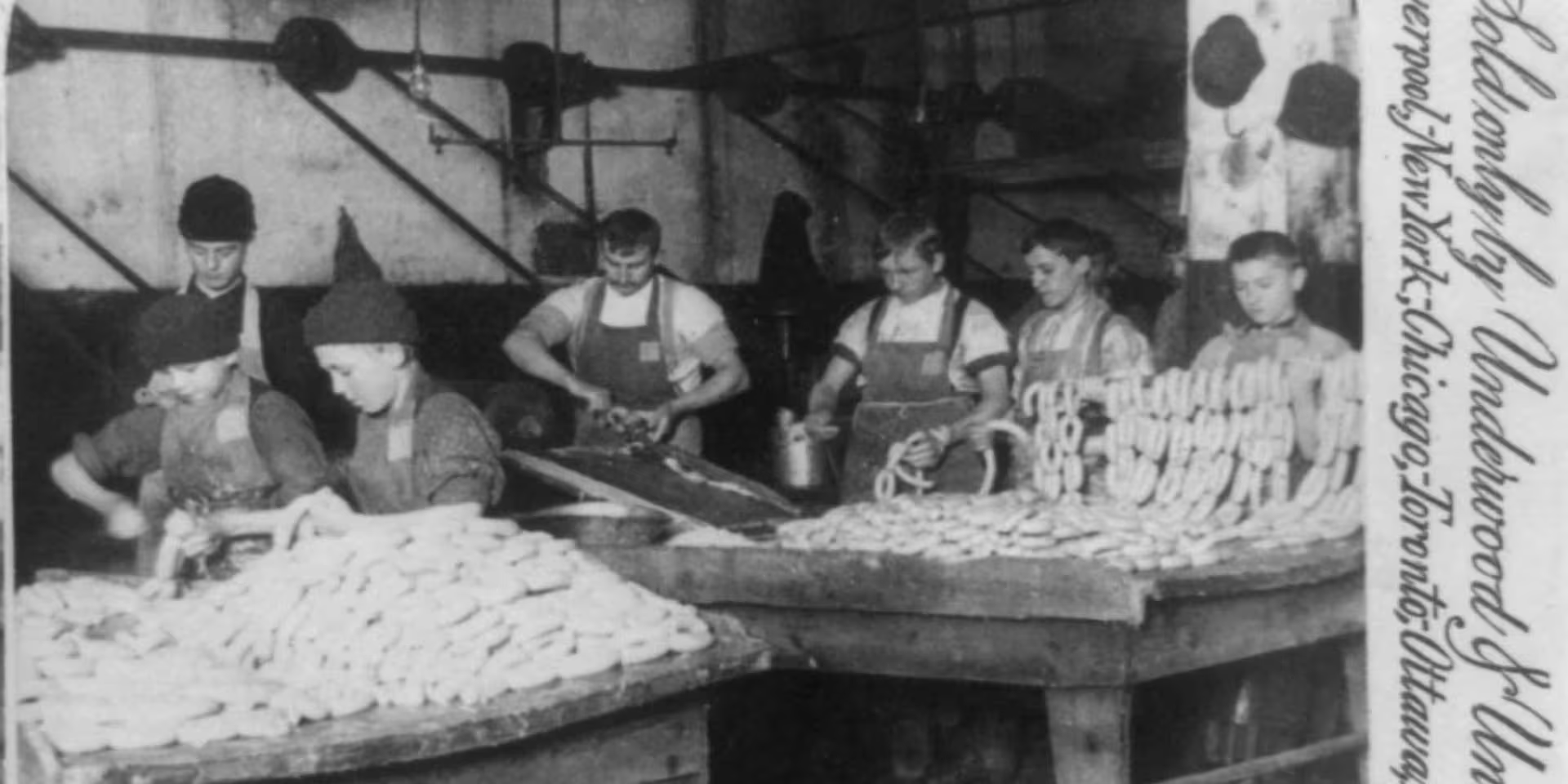
Just six months after The Jungle, Upton Sinclair’s towering rebuke of capitalism, wage slavery, and a lack of food safety regulations that echos many of the trends we are seeing today was published; both the Meat Inspection Act and the Pure Food and Drug Act were signed into law on June 30, 1906. The legislation inspired by The Jungle eventually lead to the formation of two of the federal agencies that are tasked with keeping Americans safe – the Food and Drug Administration (FDA) and the United States Department of Agriculture’s Food Safety and Inspection Service (USDA FSIS). The author spent weeks undercover at a Chicago meat packing plant, living and working with immigrant laborers forced to work in horrific conditions for low pay just to survive in “the land of opportunity”. The Jungle exposed not only the horrific working conditions but also the “uncleanly and dangerous to health” preparation of the food products, as described by President Theadore Rosevelt after conducting an investigation into the Chicago meatpacking district where The Jungle takes place. Reportedly while reading the book that triggered the investigation, Rosevelt threw his breakfast sausage across the room and briefly became a vegetarian (Cherny, 2008).

In a time of blatant corruption, inequality, poor working conditions, and questionable food safety – the themes of The Jungle are as relevant today as they were over a century ago. One contrast between today and when the legislation that formed the basis for the FDA and USDA was originally passed; we have the regulations and systems in place that should protect us and our pets from dangerous, unclean food. Unfortunately the agency, which has been underfunded for decades; has fallen victim to DOGE, Robert F. Kennedy’s HHS, and the Trump administration’s campaign to “reduce” the size of the government – no matter the consequences. One of the more visible effects of the budget cuts and layoffs has been a significant decline in food safety, with outbreaks ranging from botulism in baby formula; to the more recent salmonella found in granola, salad dressing, jalapeños, and animal food; glass in fruit popsicles; and metal in sourdough.
Between August 1 and August 20, 2026 the FDA issued 20 recalls for food due to contamination (12), undeclared allergies (5), and foreign bodies (3); for context during the same timeframe last year there were 8 recalls (FDA).
Some have suggested that the 250% increase in recalls was do to increased surveillance efforts, but given that staffing at the FDA and CDC have been reduced by at least 20% it seems highly unlikely (Olmsted, 2026; Pogue, 2026).
It isn’t just staffing that has been cut under the Trump Administration; important food safety labs have been closed and whole programs have been eliminated. A FDA food safety lab in San Fransisco that tested a quarter of the baby formula in the U.S. and that was the only lab in the country capable of testing for bird flu contamination in pet food was closed (Miller, 2025). [Author’s note: the lack of testing for bird flu contamination in pet food is concerning because dogs and cats can become infected with bird flu and there has been at least one case of a domestic cat transmitting bird flu to a human (CDC, 2025; AVMA, 2026)]. The same San Francisco lab was also responsible for many major food safety investigations given that they had close proximity to more than half of the produce grown in the United States (Miller, 2025).
The National Advisory Committee on Microbiological Criteria for Foods (NACMCF) which was disbanded in February 2025 this advisory committee worked with the FDA and USDA and their Mexican counterparts on ways to prevent microbial contamination in food (Pogue, 2025). On July 1, 2025 budget cuts forced a drastic reduction in active tracking conducted by FoodNet – the Foodborne Diseases Active Surveillance Network that used to track eight pathogens, including cyclospora, now only actively tracks salmonella and Shiga toxin-producing E.coli (STEC). Although the FoodNet website says that the 10 states that participate in the program can continue to voluntarily report the 6 pathogens they used to actively track. Voluntary reporting is better than nothing, but it is typically less timely than active surveillance; and because food is perishable having prompt information can make all the difference (Bendix, 2025). The FoodNet program, the primary foodborne disease tracking system in the CDC’s Emerging Infectious Disease Program, was established after the devastating E.coli outbreak in 1993 in Washington State and has been monitoring foodborne illnesses and making food safer for Americans for the past 30 years (Zuraw, 2015). In addition to ridding us of important public health programs that could have prevented or reduced the recent swath of food recalls; the Trump administration also delayed the launch of a food safety bill passed by Congress in 2011 that included a Traceability Rule – legislation intended to go into effect this year that would have required any food-related company to keep detailed supply chain records for vulnerable ingredients from the field to the store (Pogue, 2025). Given how difficult it has been for the FDA to verify the origin of the recent cyclosporiasis outbreak that lead to almost 16,000 confirmed cases, 828 hospitalizations, and 2 deaths (CDC, Aug 18, 2026). Although lettuce from Taylor Farms de Mexico is strongly suspected to be the source of the outbreak, it took the FDA a month from reports linking Taylor Farms de Mexico’s lettuce to sending agents out the site for inspection (Time, 2026, Olmsted, 2026). As of the most recent update on the cyclosporiasis illness on August 27, 2026 the FDA was still onsite conducting their investigation of the outbreak HHS Security RFK, Jr. said was “under control” as early as July 21, 2026 (FDA, 8/27/2026; Farrow, Benadjaoud, and Schulze, 2026).

Despite all the havoc the Trump administration has manufactured in the last 20 months, the possible impending collapse of our public health infrastructure does not rest entirely on the shoulders of those that are currently in power. Like most of the infrastructure in the United States, the public health systems the Trump Administration inherited on January 20, 2025 was fragile and degraded; functional, but severely hamstrung by decades of insufficient funding, unreasonable demands from Congress, and a bloated backlog of inspections that only worsened during the COVID-19 pandemic (Miller, 2025). One such factory that the FDA has had difficulty inspecting in the past is Taylor Farms de Mexico, which was last inspected in 2019 and prior to that was inspected in 2013 during another cyclosporiasis outbreak (Ingram, 2026). The 2013 outbreak was much smaller than the current outbreak, by comparison the current outbreak has impacted 25x more people than the 2013 outbreak (CDC, 2024). It is possible that part of the reason the current outbreak is so significant is due to weakened food safety legislation; but it is far more likely that it is directly tied to the fact that Taylor Farms supplies roughly 40% of the salad kits sold in American grocery stores and is one of the world’s largest producers of fresh-cut vegetables and salads (Gomez, 2026). Taylor Farms is just one of the mega corporations that control roughly 80% of the grocery item market in the United States (Lakhani, Uteuova, and Chang, 2021). This consolidation in food production makes consumers vulnerable to price gouging, food shortages, and foodborne illness outbreaks while the companies that control our food rake in record profits (Kelloway, 2022). Not only does consolidation make American consumers susceptible to abuses by the companies themselves; it also makes the food supply chain as a whole brittle, weak, inflexible, and have a tendency to break down.

To add another layer of complexity to the matter there is a small group of radicals working very hard to take over our country at both a local and national level. Christian Nationalists with deep pockets have bought up large portions of Battle Ground, Ridgefield, and the Republican party are doing their very best to dictate the future of the United States. In 2023 the Heritage Foundation published a 900 page manifesto on how it planed to dismantle large swaths of the U.S. Government in order to build a system that looks like and benefits them – white, Christian Nationalist, ultra-conservative, and male. Each chapter of this offensive proclamation details many reforms we have already lived through, including chapter 10 of Project 2025. Focused on the USDA, it states that the organization’s mission statement to provide food that is both good for all Americans and our planet was “too broad”; instead the Heritage Foundation would prefer that the governmental oversight that helps keep us safe from corporate greed be reduced or eliminated in order to lower food prices and increase efficiency. In addition, the Heritage Foundation wants to remove social safety nets like SNAP (Supplemental Nutrition Assistance Program), WIC (Women, Infants, and Children), and farm subsidies that not only feed Americans but also keep American farmers profitable. In the past 20 months we have seen many of these changes come to fruition and what we have gained is food that is both outrageously expensive and unsafe to eat; farmers losing their farms; and more Americans skipping meals, relying on food assistance, and dipping into their savings to buy groceries (Kosar, Mehta, and van der Klaauw, 2026).
What can we do when we no longer know if our food is safe to eat? When the Trump administration is allowing the importation of 300,000 tons of questionable ground beef to be imported into the U.S. without inspections (Whitfill Roeloffs, 2026)? The solution to this and to many other problems we will face during this era is to come together as a community.
Shop local; grow your own food (in individual or community gardens); trade with your neighbors; and be a conscious consumer of both products and media.
The less we rely on a compromised system and rely instead on each other, the greater chance of success we have. We need not be held hostage by the tyrannical forces that surround us – we can choose another path – one of diversity, of inclusion, of resilience.
Further Reading and Sources:
American Veterinary Medical Association (AVMA). CDC confirms cat-to-human transmission of avian influenza. May 13, 2026.
Bendix, Aria. The CDC quietly scaled back a surveillance program for foodborne illnesses. NBC News. Aug 26, 2025.
CDC. Avian Influenza (Bird Flu): Bird Flu in Pets and Other Animals. Mar 7, 2025.
CDC. Multisate Cyclospora Outbreak. August 9-29, 2013. CDC Office of Readiness and Response.
Cherny, Robert. The Jungle and the Progressive Era. The Gilder Lehrman Institute of American History. Summer 2008. Issue 16.
Cunningham, Mary. Wealth inequality in America just hit its widest gap in more than 3 decades. CBS News. Jan 21, 2026.
Farrow, Fritz, Benadjaoud, Youri, and Schulze, Elizabeth. RFK Jr. says cyclosporiasis outbreak is ‘under control’ amid at least 1,600 cases in 5 states. ABC News. July 21, 2026
Food and Drug Administration. Recalls, Market Withdrawals, and Safety Alerts. Accessed 8/20/2026.
Gomez, Brandon. How Taylor Farms became integral to America’s food supply system. CNBC. Aug 28, 2026.
Heritage Foundation, The. Mandate for Leadership. The Conservative Promise. Project 2025 Presidential Transition Project. 2023
Kelloway, Claire. U.S. food prices are up. Are the food corporations to blame for taking advantage? Time. Jan 14, 2022.
Kosar, Gizem, Mehta, Ishva, and van der Klaauw, Wilbert. Food Insecurity and Consumer Pessimism. The Federal Reserve Bank of New York. May 27, 2026.
Lakhani, Nina, Uteuova, Aliya, and Chang, Alvin. Revealed: the true extend of America’s food monopolies, and who pays the price. The Guardian. July 14, 2021.
Ingram, Julia. Farm Linked to Cyclosporiasis outbreak hasn’t been inspected in 7 years as FDA lags on foreign inspection targets. CBS News. Aug 12, 2026.
Miller, Henry. FDA in Crisis: How Trump Administration Downsizing is Slowing Medical Innovation and Endangering Public Health. American Council on Science and Health. May 1, 2025.
Mosbergen, Dominique. Is Lettuce Safe to Eat? The Latest on the Cyclosporiasis Outbreak. Time. July 21, 2026.
Olmsted, Edith. FDA Only Now Goes to Mexico to Investigate Explosive Diarrhea Outbreak. The New Republic. Aug 14, 2026.
Olmsted, Edith. Food Safety Keeps Getting Worse Under Trump. The New Republic. Aug 20, 2026.
Pogue, David. How Trump admin cuts have compromised food safety. CBS News. July 26, 2026.
Sainato, Michael. As billionaires’ wealth sores, US workers struggle: ‘The rich keep getting richer for no good reason’. Jan 26, 2026.
Sinclair, Upton. The Jungle. Doubleday, Page & Co., 1906. Project Gutenberg. From ANCHOR. Library of NC.
Whitfield, Thomas. Inside the FDA After DOGE: Six Former Staffers Describe What Was Lost When the Cuts Came. Political.Org. May 7, 2026.
Whitfill Roeloffs, Mary. Trump confirms tariff-free beef is coming from Brazil and Argentina amid quality controversies. Forbes. 9/5/2026.

Leave a Reply