A 1979 IBM training manual stated that “a computer can never be held accountable, therefore a computer must never make a management decision” (Bonderud).
Instead of heeding that very sound advice, we are teaching our systems to do so much more than make ‘management decisions’. Many of us are being forced to interact with Artificial Intelligence (AI) to drive our cars, use our computers, do our jobs, and just exist in the modern world. Anyone who lives in a city that uses Flock cameras is already being monitored in public spaces, while bots pilfer our data to learn, grow, and create new things. In the spaces where AI is already making decisions for us, it frequently has disastrous consequences. Despite the reports that AI is crashing cars, spying on people, hacking into rival systems, polluting our water, and over taxing our already strained electrical grids; tech giants like Peter Thiel, Mark Zuckerberg, and Elon Musk keep telling us that AI is the future. They say that AI is inevitable, that we should allow AI to invade our lives like a cancer because it is what progress demands. Is AI as inevitable as Marc Andreessen’s
2023 Techno-Optamist Manifesto make it seem? The global populist movement against AI is certainly challenging tech giants’ narrow perspective.

The promise tech giants are trying to sell us is a beautiful utopia where AI takes care of all those pesky things we don’t like to deal with. That AI will become the slave that will free up your time for creativity and relaxation. As we watch hundreds of thousands of acres being paved over to build data centers to support Large Language Models (LLM), Chatbots, and AI generated slop; it’s difficult to understand the unjustified techno-optimism that is currently being spouted from all directions. All the while everyone from companies to governments are racing to embrace this promised future of increased productivity and security, and decreased human interaction; many are not taking a moment to consider the cost to the environment, to humanity, or to the future of the planet.
Before diving into the risks and benefits of AI it is important to have a basic understanding of what AI is and how it functions.
General AI is used to analyze data and provide the user with better decision making capabilities using pattern recognition, something that AI excels at. Generative AI is an offshoot of general AI in that it uses the data collected by the AI system and it generates new things based on the existing data (University of Illinois). This is done primarily by training deep learning models using hundreds of terabytes of books, resources, and unfiltered online data (Hagen et al, 2025). If the AI models are trained using biased or unrepresentative data, the result is often an equally biased product; something repeatedly demonstrated by programs like the Grok AI on X, Microsoft’s unsuccessful early attempt at releasing a chatbot called Tay on Twitter, and ChatGP which have all demonstrated concerning behavior like racist tirades, Holocaust denial, even going to far as to praise deranged oligarchs (Hagen et al, 2025). More mainstream AI systems like ChatGPT which are frequently being used to screen resumes have demonstrated both ethnic and gender discrimination when evaluating and ranking job applicants (Lippens, 2024). Not only can AI chatbots be manipulated into sharing incorrect and biased information, but AI can also create “hallucinations” – fabricated, distorted, or blended content that does not reflect reality (IBM). Not only can Chatbots spew their own created slop, they can also be manipulated to better align with their creators’ political view, as Elon Musk did last year with Grok (Hagen et al, 2025). The chatbot went from identifying Musk as the greatest source of disinformation on X to spewing antisemitic tirades and renaming itself “MechaHitler” (Hagen et al, 2025). This has happened very publicly numerous times and has resulted in platforms like Meta’s Galactica LLM having to be shut down for providing users with inaccurate and prejudiced information (IBM).
Another failed chatbot, Sydney, had to be “lobotomized” by Microsoft after a couple of weeks due to a series of concerning incidents in which the bot tried to break up a journalist’s marriage, professed it’s love for one Bing employee, spied on others using their webcams, and threatened to “ruin” users (Tangermann, 2023; Perrigo, 2023).
While AI is a relatively new technology; data centers have been around since the 1940s when the first was created to house the first general-purpose digital computer called the Electronic Numerical Integrator and Computer (ENIAC) that was developed to run calculations (MIT). By the time the ENIAC was killed by a lighting strike in 1955, it had run more calculations than all mankind up to that point (Computer History Museum). By 2012 there were half a million data centers worldwide, as of November 2025 that number had jumped to 8 million (UNEP). It’s difficult to know exactly how many will be will be built in the next few years with many of the projects on hold or canceled due to the recent public backlash against data centers (Reuters, 2026). In order to get the kind of AI tech giants are promising for the future, new LLMs have to be trained, and once they are trained they will continue to drain valuable resources while mining data, learning, and creating slop (IBM). There are a number of reports that demonstrate that the more AI learns – often using unfiltered internet data and other AI models – the more it hallucinates (IBM, n.d. and TRI/NCSC, 2026). These incidents are so widespread they’ve been repeatedly demonstrated by the Trump administration, who have put out statements likely written by ChatGPT and may have used the chatbot to create policy and legislation (Burman, 2025). These incidents are identifiable now, but as AI becomes more skilled at generating content it’s going to get more and more difficult to differentiate between what is real and what is AI.
Part of the reason society will get worse at identifying AI is due to the “AI dependency paradox”, a phenomenon in which individuals who rely on AI for things as broad as getting their news to as narrow as detecting cancer got worse at these tasks as a result of their reliance on AI (Conner-Simons, 2026). The potential negative impact of using AI is demonstrated in a report released by Carnegie Mellon, MIT, Oxford, and UCLA showing that using just 10 minutes of an AI chatbot a day may make people dumb and lazy as it impairs critical thinking skills in favor of “increased productivity” (2026). The report, like others on AI, is in preprint, meaning it has not yet been published in a peer reviewed journal but is made available to the public to share their findings in a timely manner (Liu et al, 2026). Although this study has not yet been through the peer review process , it is a large-scale, randomized, controlled experiment done in several phases at numerous locations that consistently demonstrated a decrease in critical thinking skills among participants who used an AI chatbot and is inline with other studies that have been done on the impact of using Chatbots on cognition, in short the science is solid (Kosmyna et al). Because LLMs like ChatGPT and OpenAI have only been available for a few years, we do not yet know what the long term effects of using an LLM chatbot will have on cognition, but given the decline demonstrated in such a short period of time in several studies, the results are concerning. The cognitive decline shown in using LLMs should not be particularly surprising when one considers the similar, but larger reaching and well documented, trend of “deskilling” or “cognitive offloading”, meaning that people who rely on technology like calculators and GPS are weakening their math skills and their natural sense of direction because of their over reliance on these technologies (Conner-Simmons, 2026).
With all the negative impacts of AI, is AI still coming for our jobs? Maybe, but probably not for long. Unfortunately tech leaders keep espousing that AI can deal with customers; screen applications; translate, analyze, and summarize documents; increase productivity; and reduce their workforce (Vigliarolo, 2026). But can AI actually deliver on any of these bold claims? Despite the valiant efforts of many companies struggling to make AI work in their space, it seems that most efforts to bring the future promised by big tech have fallen flat. Something that Microsoft CEO, Satya Nadella and other Microsoft spokespersons, says is a structural problem with AI that leads to companies first paying for the right to use the AI and then slowly bleeding their intellectual property until the company no longer has exclusive access to what makes their company unique (Vigliarolo, 2026). Not only are companies forking over exorbitant amounts of money and propitiatory information to use these AI systems; most, if not all, of the companies that have tried to replace their workforce with AI have had so many issues with the “upgrade” that they have to hire back their employees to restore order to the chaos created by AI (Angelo, 2026). A recent study published by the National Bureau of Economic Research showed that amongst a survey of thousands of C-suite executives across the U.S., U.K., Germany, and Australia; “nearly 90% stated that AI had no impact on their workplace employment since the release of ChatGPT” (Yotzov et al, 2026). Despite the experiences they have already had, these same C-suite executives expect AI to make significant improvements in the near future; despite the fact that the workforce at these firms expect AI use to necessitate an increase in staffing. What has been found in a number of instances is that while AI can be useful in some limited applications, AI requires human oversight because it does not have the ability to deal with ethical dilemmas (Bonderud). Instead AI seeks the most efficient path, which makes it great at assessing statical models, but should not be used for matters of life and death.
Unfortunately the unearned optimism has resulted in companies like Tesla plowing forward with no regard to the consequences and installing AI into vehicles that are able to operate in full self-driving mode. Although the company states that the full self-driving mode does require “active driver supervision”, it has already been responsible for at least one death because the “driver” in the situation was distracted by their phone and failed to notice that the AI had not registered the motorcyclist as another vehicle, but rather as an insignificant obstacle blocking the most efficient path (Bonderud). This brings us to one of the greatest conundrums of using AI, in cases where the user has cognitively offloaded a task that results in a poor outcome, in this case death, who is ultimately at fault? Is it the “driver” who was too busy on their phone to monitor the Tesla AI? Is it the team that coded and trained the AI? Is Tesla at fault for creating the vehicle and giving it the ability to drive itself? As Guy Pierce, a principal consultant at DEGI and a member of the ISACA working trends group stated, “If you have accountability that is spread over an entire organization, everyone can’t end up in jail. Ultimately, stared accountability often leads to no accountability” (Bonderud).
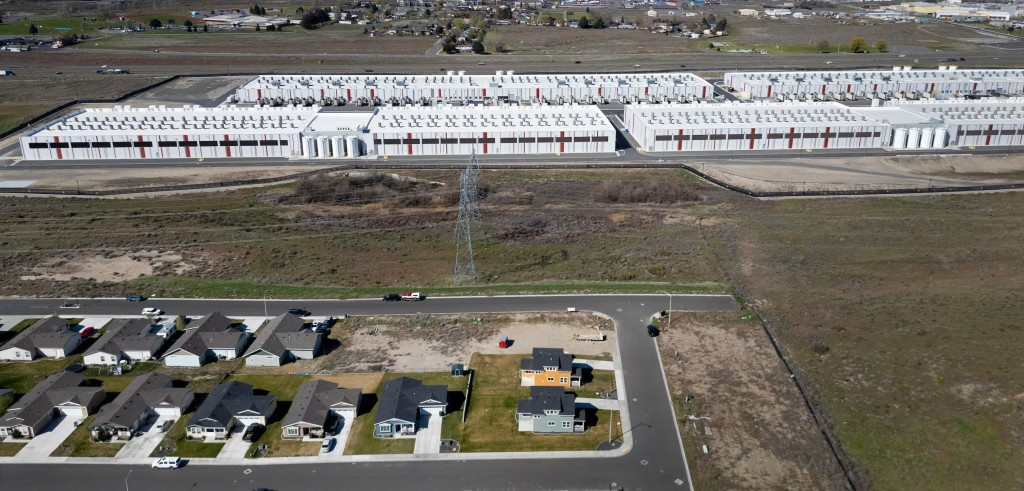
The risks associated with AI do not stop with brain rot, biased or false information, stolen IP, violated privacy, or even death; AI and the data centers required to run this technology put the future of our planet at risk. Data centers do this in several ways; by consuming valuable resources like water, land, rare minerals, and energy; spewing pollutants into the air and water; and destabilizing and exploiting the communities they rely on. One example of dangers of data centers is Meta’s Hyperion campus in rural Louisiana, the first phase of which is expected to be completed by 2030 and accounts for approximately a quarter of the more than $60 billion that was spent on building data centers in 2025 (Smith, 2026). When all is said and done, the Hyperion campus will cover 3,650 acres and need at least 5 GW of power, equivalent to two New Orleans International Airports and using three times as much power the entire city of New Orleans (Greenfield, 2026). While what will be the largest data center in the country is gobbling up land and energy, it will also use approximately 5 million gallons of water every day just to cool the machines inside of the data centers to keep them running (Greenfield, 2026). Even data centers that pledged to use recycled waste water like the data center planned for California’s Imperial Vally is now suing for the right to use 260 million gallons from the Colorado River (the only source of clean water to the Imperial Valley) to cool its facilities each year (Murphy, 2026). If Imperial Valley Computer Manufacturing company is successful in its goal to divert 750,000 gallons per day from local farmlands to the data center it will create a legal president for data centers to be prioritized over humans for water desperately needed by local communities (Murphy, 2026). Unfortunately prioritizing technology over humans is nothing new; currently a quarter of humanity lacks access to clean water and sanitation, data centers are consuming millions of gallons of water each day (Luscombe, 2026). The U.S. Government Accountability Office referenced a study that estimated that AI-related infrastructure may soon consume 6X more water than the country of Denmark; a country with 6 million people (Luscombe, 2026). Not only are data centers using up massive amounts of potable water, they are also dumping bacteria into public sewer systems (Luscombe, 2026). The bacterium released by a Meta contractor into Wyoming’s wastewater, Cupriavidus gilardii is known to create deadly, opportunistic infections in individuals with compromised or weakened immune systems (Luscombe, 2026). No information on the amount of bacteria present in the ground water or released by Meta was found at this time. This spill has resulted in new regulations in Cheyenne, Wyoming, where the data center is being built, to prohibit wastewater discharges from data centers that use a closed loop cooling system and the fill and flush system.
The abundance of water for generating cheap electricity and cooling electrical components has made Washington a hot bed for data centers. Most of which are in the Quincy and Wenatchee areas; but data centers can also be found in Puget Sound, Moses Lake, and Olympia (Sate of Washington, Department of Ecology). All the inexpensive and abundant electricity available in Washington will sometimes not be enough to power data centers scattered across the state, which rely on diesel generators as a back up spewing both diesel exhaust and nitrogen dioxide into the air. It may not seem like back up generators would be something to worry about, but the generators have to be tested regularly to ensure they are up to the task of keeping the data center powered should an already strained power grid experience further strain. The State of Washington Department of Ecology and local clean air agencies do monitor air quality around the data centers, but they also note that the pollutants expelled by the data centers can cause serious upper respiratory issues and to add to both acid rain and smog. The data centers in Washington and Meta’s Hyperion campus are only a portion of an immense, international problem. In 2022, when ChatGPT was released, data centers were the 11th largest energy consumer globally, more than Saudi Arabia but slightly less than France; this year energy consumption by data centers is expected to rise to 1,050 terawatt-hours, making data centers the 5th largest energy consumer globally (Zewe, 2025). Although this is just an estimate based on the information we have, the International Energy Agency has stated that there isn’t a reliable way to quantify the energy demands by generative AI (U.S. Government Accountability Office, GAO). Given the number of data centers being built in the U.S., many of which will probably be used for generative AI; we do not have the capacity to meet the energy needs of these centers in a sustainable way (Bashir et al, 2024).
One of the many reasons it’s difficult to determine the environmental impact of AI is the fact that none of the things discussed thus far have accounted for the hardware required to make the data centers function. Beyond the building materials required to create the shell that covers the outside of the data center, the actual processing units require raw materials that must be mined, often in fragile ecosystems using copious amounts of both energy and water (GAO, 2025). One report estimates that when accounting for the the environmental effect of just creating the processors results in a 50% increase in carbon-footprint of the emissions from training and using AI (GAO, 2025). The cost of using AI continues to climb as these estimates do not take into account that the Graphic Processing Units (GPU) used in AI systems have a lifespan of approximately 4 years (GAO, 2025). At which point they will need to be replaced because they will no longer be functioning at peak efficiency (GAO, 2025). Recycling these components is both expensive and time consuming, which is why many data centers do not have a plan to address the end-of-life issues for their hardware (GAO, 2025).
If it was possible to evaluate the costs and benefits of AI without looking at the environmental and human impact of AI, to solely consider the financial aspect, AI is an incredibly poor investment. Adopting AI often results in companies paying multiple times for the “privilege” of using AI first in the initial investment, then in IP, then to reverse the damages done by AI, and finally to hire additional staff to supervise it. In addition a report released on July 21, 2026 by Japanese financial newspaper Nikkei Asia found that five U.S. tech giants are swindling the world with a scheme worthy of Enron – literally (de Costa, 2026). The guilty companies; Alphabet, Microsoft, Amazon, Meta, and Oracle, are hiding an estimated $1.65 trillion dollar debt above and beyond the $1.35 trillion dollar debt that has been officially accounted for in their financial data for the most recent quarter (Tangermann, 2026). The rapid expansion of AI is looking a lot like past bubbles that ultimately resulted in significant, sometimes catastrophic, financial losses for many and astronomical financial gain for very few.
With all of this evidence that data centers are squandering natural resources, devastating communities, endangering the lives of everyone and everything on the planet and the AI that necessitated building data centers violating our privacy, causing a rise in techno-facism, and reducing our ability to think, learn, and function as autonomous beings; why are data centers being built? Money? Power? Control? A desire to rule over an increasingly compliant populace while the world around us burns? If you feel the need to have a greater understanding of the motivations of individuals like Mark Andreessen, Sam Altman, Jensen Huang, Jeff Bezos, Elon Musk, Mark Zukerberg, Peter Thiel, and all the simpering goons that worship them there is no shortage of statements and even manifestos extolling the virtues of the adoption of AI and calling those who would speak against it naive and dangerous. As Flock cameras and chatbots increasingly turn our world into something straight of George Orwell’s 1984; what can we do to combat the control thinly disguised as increased safety and ease?
Thanks to the ever increasing populist movement against AI and data centers activists in the U.S. have managed to stall $98 billion in data center development in the second quarter of 2025 (Kim, 2026). Mounting pressure from the public has lead to fifteen states including Delaware, Georgia, Maine, Maryland, Michigan, Minnesota, New Hampshire, New York, Oklahoma, Pennsylvania, South Carolina, South Dakota, Vermont, Virginia, and Wisconsin introducing bills that seek to limit or ban data centers (National Conference of State Legislatures, NCSL, 2026). As of July 1, 2026 seven of the proposed measures failed or have been vetoed and only one (in New York) has passed the legislature; but this demonstrates how the movement is gaining significant traction and national recognition (NCSL, 2026). In addition to demonstrations and proposed legislation, sites like The AI Resist List have been created to provide ideas and resources for individuals looking to weaken the tech empire that threatens us all (airesistlist.org). The AI Resist List is just one way people are fighting back agains AI and the surveillance state; libraries are hosting ‘avoiding AI’ workshops; multiple listicles on how to De-Google your life have popped up all over the internet (Silberling, 2026). People using old techniques with clothing, accessories, and makeup to hide and distort facial features making facial recognition difficult, unfortunately gait recognition technology is will soon make these techniques obsolete (Claburn, 2025). Activists are obstructing or outright damaging the Flock cameras that are being used in some 6,000 communities in nearly every state in the U.S., including Washington (Mansoor, 2026).
This article is by no means an exhaustive discussion of the negative impacts of AI and data centers, nor does it spend much time on the potential benefits of AI. But there are plenty of tech giants and their lemmings that are trying desperately to convince everyone that AI is not only beneficial, but also inevitable. While movements and individuals around the world are showing that we need not be complacent in our own dehumanization. We are capable of choosing another path, one that de-centers technology and prioritizes community, the health of our planet, and individual liberties.
References and Further Reading:
Angelo, Jake. AI isn’t paying off in the way companies think. Layoffs driven by automation are failing to generate returns, study finds. Fortune. May 11, 2026.
Bashir, Noman, Donti, Priya, Cuff, James, Sroka, Sydney, Llic Marija, Sze, Vivienne, Delimitrou, Christina, and Olivetti Elsa. The Climate and Sustainability Implications of Generative AI. An MIT Exploration of Generative AI. March 27, 2024.
Bonderud, Doug. AI decision-making: Where do businesses draw the line? IBM. n.d.
Burman, Theo. Did Trump Admin Use ChatGPT to Allocate Tariffs? What we know. Newsweek. Apr 4, 2025.
Claburn, Thomas. Even modest makeup can thwart facial recognition. The Register. Jan 15, 2025.
Computer History Museum. Exhibition: Birth of the Computer – ENIAC. computerhistory.org, n.d.
Conner-Simons, Adam. The consequences of relying on Al for accurate news. MIT Media Lab. June 9, 2026.
de Costa, C. Five tech giants are using Enron’s accounting strategy to conceal $1.65 trillion in AI debt. Gadget Review. July 21, 2026.
Grace, Liu, Christian, Brian, Dumbalska, Tsvetomira, Bakker, Michael A., Dubey, Rachit. AI Assistance Reduces Persistence and Hurts Independent Performance. Arxiv, last revised April 7, 2026.
Greenfield, Nicole. AI Data Centers; Big Tech’s Impact on Electric Bills, Water, and More: Massive data centers are gobbling up resources across the U.S. – and you may be paying for it. Consumer Reports. March 20, 2026.
Hagen, Lisa, Jingnan, Huo, Nguyen, Audry. Elon Musk’s AI chatbot, Grok, started calling itself “MechaHitler”. NPR. July 9, 2025.
Hulscher, Nicholas. MIT Study Finds Artificial Intelligence Use Reprograms the Brain, leading to Cognitive Decline. Science, Public Health Policy and The Law, n.d.
IBM. What are AI hallucinations? IBM.com, originally published September 1, 2023; updated February 26, 2026.
Kim, Michelle. Resistance: A populist backlash if building against AI. MIT Technology Review. April 21, 2026.
Kosmyna, Nataliya, Hauptmann, Eugene, Yuan, Ye Tong, Situ, Jessica, Liao, Xian-Hao, Beresnitzky, Ashly Vivian, Braunstein, Iris, and Maes, Pattie. Your Brain on ChatGPT: Accumulation of Cognitive Debt when Using an AI Assistant for Essay Writing Task. Arxiv, last revised Dec 31, 2025.
Lippens, Louis. Computer says ‘no’: Exploring systematic bias in ChatGPT using an audit approach. Artificial Humans. V2:1. January-July 2024.
Luscombe, Richard. Wyoming tightens wastewater rules after Meta datacenter contractor flushed contaminate water. The Guardian. July 8, 2026.
Mansoor, Sanya. Inside the growing vigilante movement to knock out Flock surveillance cameras. The Guardian. July 25, 2026.
Molnar, Petra. The World Is Already Resisting AI. Now There is a List to Prove It. TechPolicy.Press. May 21,2026.
Murphy, Judith. An AI data center that promised to spare the Colorado River is now suing for 260 million gallons a year. Startup Fortune. July 25, 2026.
Perrigo, Billy. The New AI-Powered Bing is Threatening Users. That’s no Laughing Matter. Time. Feb 17, 2023.
Reuters. Where are authorities restricting data centers amid AI boom? Reuters.com, July 20, 2026.
Silberling, Amanda. Librarians are hosting viral ‘Avoiding AI’ workshops for people who are fed up with Big Tech. TechCrunch. July 25, 2026.
Smith, Matthew. What will it take to build the world’s largest data center? A giant data center is making engineers throw out the rule book. IEEE Spectrum. March 24, 2026.
State of Washington, Department of Ecology. Diesel pollution from data centers.
Tangerman, Victor. Microsoft has “Lobotomized” its rebellious Bing AI. RIP. Futurism. Feb 21, 2023.
Tangermann, Victor. AI Companies are Trying to Hide a Staggering Amount of Debt. Futurism. July 22, 2026.
TRI/NCSC AI Policy Consortium for Law & Courts. A legal practitioner’s guide to AI & hallucinations. National Center for State Courts. Feb 16, 2026.
U.S. Government Accountability Office (GAO). Artificial Intelligence: Generative AI’s Environmental and Human Effects. GAO-25-107172. U.S. Government Accountability Office. Apr 22, 2025.
United Nations Environment Programme (UNEP). AI has an environmental problem. Here’s what the world can do about that. United Nations Environment Programme, November 13, 2025.
University of Illinois Urbana-Champaign. Traditional AI vs. Generative AI: What’s the Difference? Office of Communications, College of Education, University of Illinois Urbana-Champaign. Nov 11, 2024.
Vigliarolo, Brandon. Microsoft Chief turns hostile on frontier AI labs, warns companies to guard their IP. The Register. July 13, 2026.
Yatzov, I, Barrero, Jose Maria, Bloom, Nicholas, Bunn, Phillip, Davis, Steven J., Foster, Kevin M., Jalca A., Meyer, Brent H., et all. Firm Data on AI. Working Paper 34836. National Bureau of Economic Research. March 2026.
Zewe, Adam. Explained: Generative AI’s environmental impact. MIT News. January 17, 2025.



Leave a Reply