When tracking how economic and social power shifts within a region, the most telling details rarely come from public speeches alone. They are found in property deeds, corporate structures, and board appointments at influential civic associations.
In Battle Ground, Washington, Maddox Industrial Transformer—led by CEO Camden Spiller and Vice President of Real Estate Development Max Booth—has rapidly expanded from a fast-growing supplier of electrical equipment into the dominant commercial real estate holder in town. Alongside pastor and author C.R. Wiley, Maddox leadership has pursued a explicit effort described by its hosts as an “experiment in Christian localism”.
Central to understanding how this local enterprise projects influence beyond Battle Ground is its seat on Identity Clark County (ICC), the region’s prominent private business and economic development organization.
Here is an examination of Spiller’s published philosophies, Max Booth’s role, and how platforming by regional business coalitions impacts the broader community.

Corporate Worldview & Published Beliefs: Camden Spiller in His Own Words
Founded in 2015, Maddox Industrial Transformer has grown substantially by supplying new and reconditioned power equipment to data centers and industrial infrastructure nationwide. Spiller and affiliated corporate entities have used this capital to acquire over 30 parcels across Battle Ground, including land along main commercial corridors and inside BG Village. In June 2026, the Spiller family expanded its local media footprint by acquiring The Reflector, Battle Ground’s long-standing community newspaper.
Spiller has publicly outlined his philosophy on corporate governance, faith, and local expansion across public speeches, podcasts, and local editorials:
- On Corporate Worldview: Speaking at a public conference, Spiller explicitly linked corporate culture to worldview formation:“All corporations disciple their people in a certain worldview, and I wanted to build a company that reflected my own faith and values.”
- On Corporate Expansion: Spiller characterized Maddox’s aggressive growth trajectory as a “colonization kind of approach” and described remaining a small business as “treason to our time.”
Max Booth, C.R. Wiley, and “Christian Localism”
To guide physical expansion and land acquisition, Maddox employs Max Booth as Vice President of Real Estate Development.
Working closely with senior pastor and author C.R. Wiley—whose writings appear in publications such as Modern Reformation, The Imaginative Conservative, Touchstone, National Review, and First Things—Booth co-hosted a podcast series specifically dedicated to their vision for the town:
- The Battle Ground Project: Subtitled “An experiment in Christian localism,” the podcast featured Booth and Wiley discussing strategies for acquiring physical property, establishing Christian-owned businesses, and building self-sustaining local enclaves.
- Removal of Content: Following public reporting by investigative journalists at Oregon Public Broadcasting (OPB) regarding the podcast’s ties to broader Christian nationalist movements, the episodes were pulled offline.
- Physical Infrastructure: City filings and environmental assessments under the Maddox Infrastructure Development Agreement detail plans for a 14,000-square-foot chapel, 25,000 square feet of event space designed to seat 1,000 people, and 173 private cemetery plots.

3. The Role of Identity Clark County (ICC) and Platforming
Identity Clark County (ICC) is a private, non-profit business coalition made up of regional corporate executives, developers, and civic leaders. The organization focuses on regional transportation planning, land-use policies, and economic advocacy across Clark County.
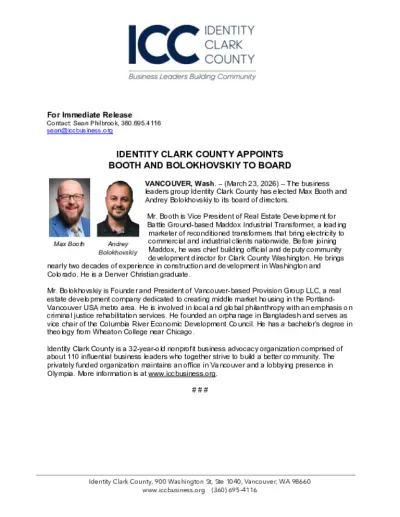
Max Booth sits directly on the Identity Clark County Board of Directors, representing Maddox Industrial Transformer alongside leaders from major health systems, financial institutions, and construction firms.
Why Regional Platforming Matters
When regional groups like ICC grant board seats to companies pursuing hyper-specific theological land acquisition, it produces several distinct consequences for the broader community:
- Institutional Legitimacy & Normalization: Inclusion on the ICC Board elevates corporate executives into recognized regional civic leaders. This validates aggressive local real estate accumulation as standard commercial economic development, insulating the underlying ideological objectives from public scrutiny.
- Access to Regional Infrastructure Planning: ICC maintains direct access to county planners, state legislators, and transportation agencies. Having Maddox’s top real estate executive on the board ensures that regional infrastructure and zoning priorities align with the company’s extensive commercial footprint in Battle Ground.
- Concentration of Influence: When a single corporate entity simultaneously functions as a town’s primary landlord, major employer, newspaper owner, and regional business representative, it creates an asymmetric concentration of power that diminishes civic transparency for surrounding residents.
The Takeaway for Clark County
Tracking the intersection of Maddox Industrial Transformer and Identity Clark County is not an attack on private business enterprise or personal religious conviction. It is an essential exercise in civic oversight.
When corporate capital is deployed to consolidate local land, acquire local press, and secure seats on regional economic boards, residents across Clark County deserve full transparency regarding how public policy and regional planning decisions are shaped.


Leave a Reply